Potassium Channel
KcsA
Potassium channels are the most widely distributed type of ion channel and are found in virtually all living organisms. They form potassium-selective pores that span cell membranes. Potassium channels are found in most cell types and control a wide variety of cell functions. Potassium channels function to conduct potassium ions down their electrochemical gradient, doing so both rapidly and selectively. Biologically, these channels act to set or reset the resting potential in many cells. In excitable cells, such asneurons, the delayed counterflow of potassium ions shapes the action potential. By contributing to the regulation of the action potential duration in cardiac muscle, malfunction of potassium channels may cause life-threatening arrhythmias. Potassium channels may also be involved in maintaining vascular tone.
All Product Categories
-
Potassium Channel Inhibitors
(683)
View all products
-
Potassium Channel Agonists
(31)
View all products
-
Potassium Channel Antagonists
(39)
View all products
-
Potassium Channel Activators
(240)
View all products
-
Potassium Channel Modulators
(44)
View all products
-
Potassium Channel Chemical
(1)
View all products
-
Potassium Channel Controls
(11)
View all products
-
Potassium Channel Related Products (1142)
Related Products (1142)

-
Antibodies (6)
-
Related Compound Screening Libraries (1)
-
CP-339818
 0 ImagesCat. No.: HY-114540CAS No.: 185855-91-8CP-339818 is a non-peptide Kv1.3 channel (IC50 = 200 nM) and Kv1.4 channel blocker. CP 339818 inhibits HCN channel with IC50s of 18.9 μM and 43.4 μM against HCN1 and HCN4 (high Cl-). CP-339818 has significantly weaker blocking effects on Kv1.1, Kv1.2, Kv1.5, Kv1.6, Kv3.1-4, and Kv4.2 channels. CP-339818 selectively blocked Kv1.3, thereby inhibiting the activation process of human T cells. CP-339818 can be used to study the physiological functions of HCN and Kv channels.
-
8-Azido-ATP tetrasodium
 0 ImagesCat. No.: HY-134320ASynonyms: 8-Azidoadenosine 5'-triphosphate tetrasodium; 8-N3-ATP tetrasodium8-Azido-ATP (8-Azidoadenosine 5'-triphosphate) tetrasodium, a photoreactable nucleotide analog, is useful for the identification of proteins, such as DNA-dependent RNA polymerase. 8-Azido-ATP tetrasodium is a click chemistry reagent that contains an Azide group and can undergo copper-catalyzed azide-alkyne cycloaddition reaction (CuAAc) with molecules containing Alkyne groups. 8-Azido-ATP tetrasodium can also undergo strain-promoted alkyne-azide cycloaddition (SPAAC) with molecules containing DBCO or BCN groups.
-
KCNT1-IN-2
 0 ImagesCat. No.: HY-175336CAS No.: 3087554-05-7KCNT1-IN-2 (I-42a) is a KCNT1 inhibitor. KCNT1-IN-2 can be used in research related to neurological disorders.
-
Doxapram hydrochloride hydrate (Standard)
 0 ImagesDoxapram hydrochloride hydrate (Standard) is the analytical standard of Doxapram hydrochloride hydrate (HY-B0551A). This product is intended for research and analytical applications. Doxapram hydrochloride hydrate is a respiratory stimulant. Doxapram hydrochloride hydrate increases breathing rate and depth by acting on the brain's respiratory centers and peripheral chemoreceptors. Doxapram hydrochloride hydrate inhibits TASK-1, TASK-3, TASK-1/TASK-3 heterodimeric channel function with EC50s of 410 nM, 37 μM, 9 μM, respectively. Doxapram hydrochloride hydrate inhibits the Ca²⁺-activated potassium current (IC50 ≈ 13 μM) and Ca²⁺-independent potassium current (IC50 ≈ 20 μM) in type I cells of the carotid body. Doxapram hydrochloride hydrate significantly prolongs the effective refractory period of the atrium and has an anti-arrhythmic effect. Doxapram hydrochloride hydrate can be used for the study of respiratory depression such as post-anesthesia respiratory depression, chronic obstructive pulmonary disease and apnea of prematurity.
-
Englitazone sodium
 0 ImagesCat. No.: HY-113922CAS No.: 109229-57-4Englitazone sodium is a thiazolidinedione compound. Englitazone sodium selectively activates PPARγ1 and PPARγ2. Englitazone sodium improves insulin sensitivity, induces adipogenesis in preadipocytes and mesenchymal stem cells, and inhibits the channel currents of Kir6.2-SUR1 and Kir6.2D26. Englitazone sodium is applicable to research related to non-insulin-dependent diabetes mellitus.
-
Mepyramine maleate (Standard)
 0 ImagesMepyramine maleate (Standard) (Pyrilamine maleate (Standard)) is the analytical standard of Mepyramine maleate (HY-B1281). This product is intended for research and analytical applications. Mepyramine maleate (Pyrilamine maleate) is a selective histamine H1 receptor antagonist and KCNQ channel inhibitor, with an IC50 of 12.5 μM against KCNQ2/Q3. Mepyramine maleate shows no activity against allergic asthma in mice when used alone, but modulates the effect of JNJ 7777120 (HY-13508) on allergic asthma in mice; it inhibits the development of morphine physical dependence and increases histamine levels in mouse brains. Mepyramine maleate can be used in studies related to seizures, convulsions, allergic asthma and morphine physical dependence.
-
Trimebutine maleate (Standard)
 0 ImagesTrimebutine maleate (Standard) is the analytical standard of Trimebutine maleate (HY-B0380A). This product is intended for research and analytical applications. Trimebutine maleate is a multi-target inhibitor and opioid receptor agonist with antimuscarinic activity. Trimebutine maleate inhibits L-type Ca2+ channels and large-conductance calcium-activated potassium channels (BKCa channels), thereby inhibiting extracellular calcium influx and potassium ion efflux. Trimebutine maleate also targets Toll-like receptors, inhibits Toll-like receptor 2/4/7/8/9 signals, and inhibits LPS-induced IRAK1 activation, as well as ERK1/2, JNK and NF-κB activation, thereby exerting anti-inflammatory effects. Trimebutine maleate also induces tumor cell apoptosis by inhibiting the AKT/ERK pathway. Trimebutine maleate also inhibits excessive contraction of smooth muscle and can be used in the study of gastrointestinal disorders such as irritable bowel syndrome (IBS).
-
Ropivacaine hydrochloride monohydrate (Standard)
 0 ImagesRopivacaine (hydrochloride monohydrate) (Standard) is the analytical standard of Ropivacaine (hydrochloride monohydrate). This product is intended for research and analytical applications. Ropivacaine hydrochloride monohydrate is a potent sodium channel blocker and blocks impulse conduction via reversible inhibition of sodium ion influx in nerve fibrese. Ropivacaine is also an inhibitor of K2P (two-pore domain potassium channel) TREK-1 with an IC50 of 402.7 μM in COS-7 cell's membrane. Ropivacaine is widely used for regional anesthesia and neuropathic pain management in vivo.
-
GAL-021 (Standard)
 0 ImagesGAL-021 (Standard) is the analytical standard of GAL-021 (HY-101422). This product is intended for research and analytical applications. GAL-021 is a potent BKCa-channel blocker. GAL-021 inhibits KCa1.1 in GH3 cells. GAL-021 is a novel breathing control modulator that is based on selective modification of the almitrine pharmacophore. GAL-021 increases minute ventilation in rats and non-human primates.
-
XE991 (Standard)
 0 ImagesCat. No.: HY-108577ARCAS No.: 122955-42-4XE991 (Standard) is the analytical standard of XE991 (HY-108577A). This product is intended for research and analytical applications. XE 991, a Kv7 (KCNQ) channels blocker, potently inhibits Kv7.1 (KCNQ1), Kv7.2 (KCNQ2), Kv7.2 + Kv7.3 (KCNQ3) channel, and M-current with IC50s of 0.75 μM, 0.71 μM, 0.6 μM, and 0.98 μM, respectively.
-
Fenquizone (Standard)
 0 ImagesSynonyms: MG-13054 (Standard)Fenquizone (MG-13054) (Standard) is the analytical standard of Fenquizone (HY-126179). This product is intended for research and analytical applications. Fenquizone is an orally active diuretic. Fenquizone acts primarily on the diluting segment of the nephron cortex, similar to thiazide diuretics. Fenquizone demonstrates diuretic and natriuretic potency and duration of action comparable to thiazide diuretics but weaker than loop diuretics. Fenquizone reduces CH₂O without affecting TCH₂O, does not increase calcium/phosphate excretion, and has no loop or collecting duct effects. Fenquizone is used in the study of edema and hypertension.
-
MRT2000769
 0 ImagesCat. No.: HY-122638CAS No.: 1214573-32-6MRT2000769 is a Kir7.1 inhibitor with an IC50 of 2 μM. MRT2000769 induces sustained contractions in the uterine muscle of pregnant mice. MRT2000769 is applicable for the research of postpartum hemorrhage.
-
Almitrine mesylate (Standard)
 0 ImagesSynonyms: Almitrine bismesylate (Standard); Almitrine bismethanesulfonate (Standard); Almitrine dimesylate (Standard)Almitrine mesylate (Standard) (Almitrine bismesylate (Standard)) is the analytical standard of Almitrine mesylate (HY-107319). This product is intended for research and analytical applications. Almitrine mesylate, a peripheral chemoreceptor agonist, inhibits selectively the Ca2+-dependent K+ channel.
-
N-Acetylprocainamide hydrochloride (Standard)
 0 ImagesCat. No.: HY-101433RCAS No.: 34118-92-8Synonyms: Acecainide hydrochloride (Standard); NAPA hydrochloride (Standard)N-Acetylprocainamide (Acecainide) hydrochloride (Standard) is the analytical standard of N-Acetylprocainamide hydrochloride (HY-101433). This product is intended for research and analytical applications. N-Acetylprocainamide hydrochloride is a class III antiarrhythmic, which blocks K+ channels. N-Acetylprocainamide hydrochloride exerts inhibitory effects on the maximum following frequency (MFF) of isolated rabbit atria. N-Acetylprocainamide hydrochloride can be used for the study of arrhythmias.
-
U-56324
 0 ImagesCat. No.: HY-187737CAS No.: 75587-96-1U-56324 is an orally effective ATP-sensitive potassium channel (KATP) inhibitor with an EC50 of 233 µM. U-56324 inhibits KATP channel activity in the plasma membrane of pancreatic B cells in a concentration-dependent and reversible manner, without affecting single-channel conductance. U-56324 can be used for research on type 2 diabetes and insulin secretion.
-
Daurisoline-d2
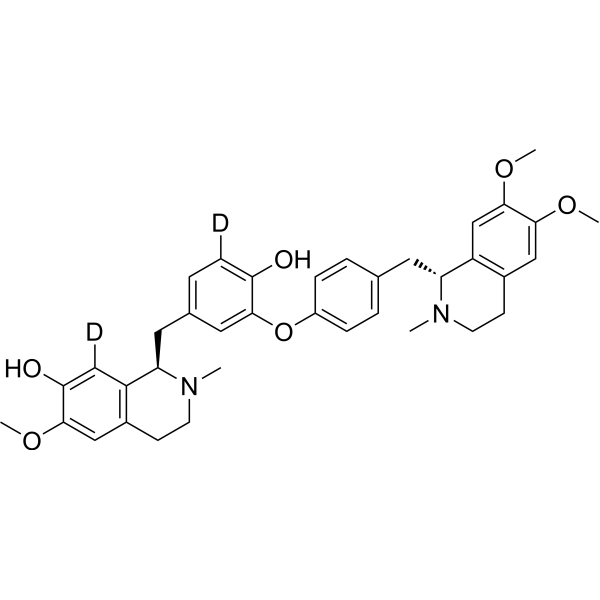 0 ImagesCat. No.: HY-N0221SSynonyms: (R,R)-Daurisoline-d2Daurisoline-d2 is the deuterium labeled Daurisoline (HY-N0221). Daurisoline is a bis-benzylisoquinoline alkaloid that can be isolated from Menispermum dauricum and Rhizoma Menispermi. Daurisoline exerts a blocking effect on hERG and has antiarrhythmic effects. Daurisoline is a potent autophagy blocker that can be used for the research of cancer.
-
Disopyramide (Standard)
 0 ImagesDisopyramide (Standard) is the analytical standard of Disopyramide. This product is intended for research and analytical applications. Disopyramide (Dicorantil) is a class IA antiarrhythmic agent with efficacy in ventricular and atrial arrhythmias. Disopyramide blocks the fast inward sodium current of cardiac muscle and prolongs the duration of cardiac action potentials. Disopyramide inhibits HERG encoded potassium channels. Disopyramide also exhibits complex protein binding, and has a potent negative inotropic action.
-
(3R,5R)-Rosuvastatin
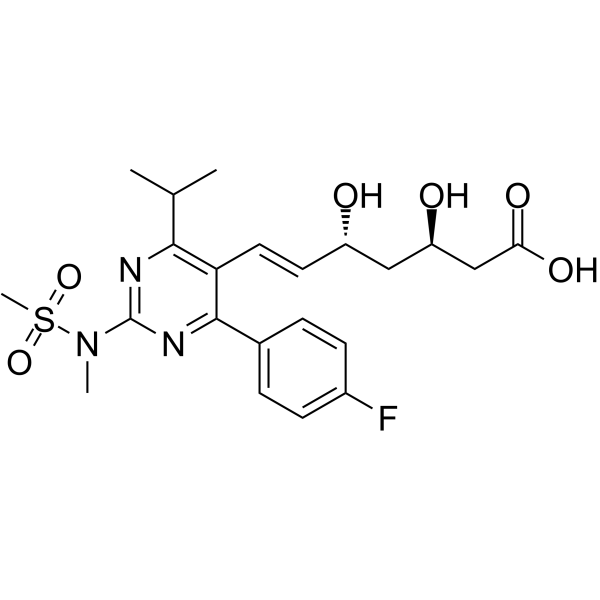 0 ImagesCat. No.: HY-17504CCAS No.: 1094100-06-7(3R,5R)-Rosuvastatin is a hERG potassium channel blocker and HMG-CoA reductase inhibitor that prolongs the action potential duration and QT interval by accelerating channel inactivation, impairing channel folding, reducing hERG mRNA transcription, and promoting the degradation of mature and immature hERG channels. (3R,5R)-Rosuvastatin can be used for research on long QT syndrome.
-
Indapamide hemihydrate
 0 ImagesCat. No.: HY-B0259ACAS No.: 180004-24-4Indapamide hemihydrate is an orally active sulphonamide diuretic agent, that can reduce blood pressure by decreasing vascular reactivity and peripheral vascular resistance. Indapamide hemihydrate is also can reduce left ventricular hypertrophy.